New research shows 64 countries cut their fossil CO2 emissions during 2016-2019, but the rate of reduction needs to increase tenfold to meet the Paris Agreement aims to tackle climate change.
Researchers involved in VERIFY (University of East Anglia (UEA) and the Global Carbon Project) and Stanford University have published on 3rd March 2021 this first global stocktake called «Fossil CO2 emissions in the post-COVID era » in Nature Climate Change.
The annual cuts of 0.16 billion tonnes of CO2 are only 10 per cent of the 1-2 billion tonnes of CO2 cuts that are needed globally every year to tackle climate change.
While emissions decreased in 64 countries, they increased in 150 countries.
Globally, emissions grew by 0.21 billion tonnes of CO2 per year during 2016-2019 compared to 2011-2015.
Prof Corinne Le Quéré, Royal Society Professor at UEA’s School of Environmental Sciences, led the analysis. She said: “Countries’ efforts to cut CO2 emissions since the Paris Agreement are starting to pay off, but actions are not large-scale enough yet and emissions are still increasing in way too many countries.
Annual cuts of 1-2 billion tonnes of CO2 are needed throughout the 2020s and beyond to avoid exceeding global warming within the range 1.5 °C to well below 2°C, the ambition of the UN Paris Agreement. The world has warmed by over 1 °C since the Industrial Revolution because of emissions of greenhouse gases from human activities.
Of the 36 high-income countries, 25 saw their emissions decrease during 2016-2019 compared to 2011-2015 and thirty of 99 upper-middle income countries also saw their emissions decrease during the same period.
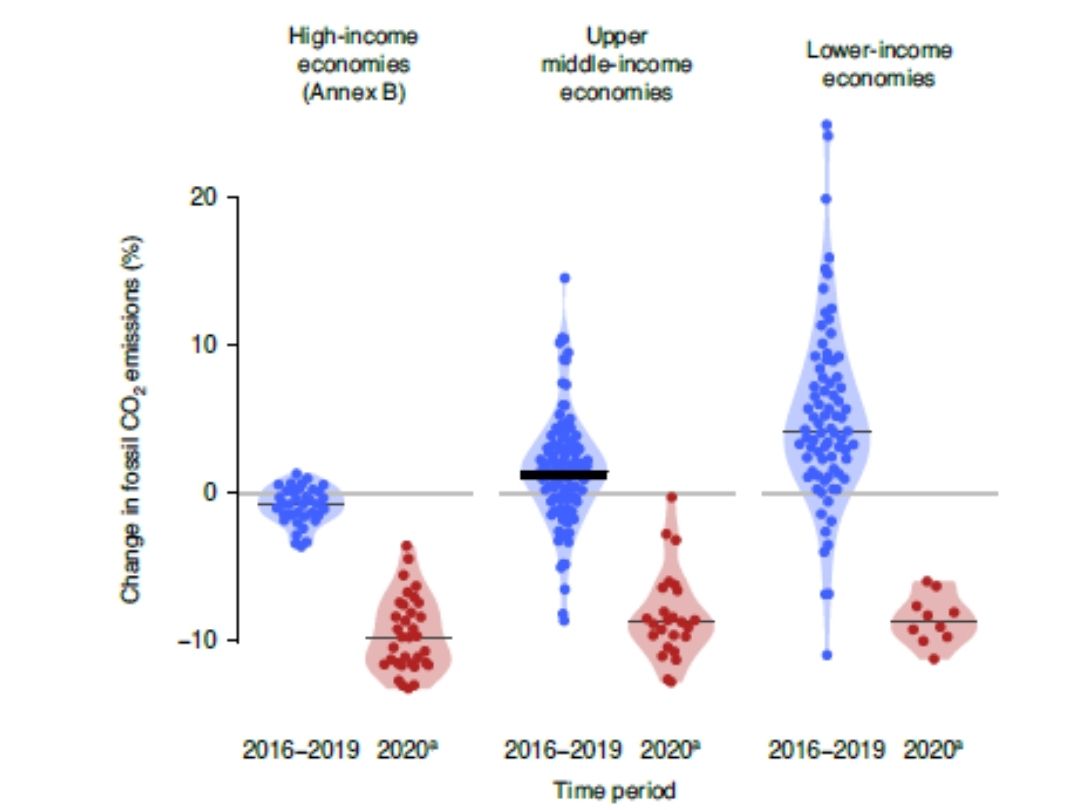
Figure 1 :Change in fossil CO2 emissions (percent per year) in the 5 years since the adoption of the Paris Climate Agreement. Changes are shown for individual countries (dots) separated in three economic groups
The growing number of climate change laws and policies appear to have played a key role in curbing the growth in emissions during 2016-2019. There are now more than 2000 climate laws and policies worldwide.
The authors say unless the COVID-19 recovery directs investments in clean energy and the green economy, emissions will likely start increasing again within a few years. The nature of the disruption in 2020, particularly affecting road transport, means incentive to expedite the large-scale deployment of electric vehicles and encourage walking and cycling in cities are timely and would also improve public health. The resilience of renewable energy throughout the crisis, falling costs, and air quality benefits, are additional incentives to support their largescale deployment.
Investments post-COVID continue to be overwhelmingly dominated by fossil fuels in most countries, in contradiction with climate commitments, including in the United States and China. The European Union, Denmark, France, the United Kingdom, Germany and Switzerland are among the few countries that have so far implemented substantial green stimulus packages with limited investments in fossil-based activities.
See the latest emissions figures comparing country by country progress with their CO2 emissions. Anthony De-Gol at UEA has created an application that enables emissions data to be shown by country: https://enactivescience.com/gcp/
The study is available in a recent paper in Nature Climate Change : https://www.nature.com/articles/s41558-021-01001-0