VERIFY project provided a direct contribution to this annual budget and the estimation of the fluxes exchanged between the atmosphere, ocean and terrestrial carbon reservoirs as well as the anthropogenic emissions (in particular with contributors from LSCE, UEA and CICERO).
The Global Carbon Budget 2020 has been published Friday, Dec. 11 at GMT 1:00 a.m., with the publication of the ESSD paper from P. Friedlingstein et al. https://essd.copernicus.org/articles/12/3269/2020/. Important and new messages were derived from the year 2020 in response to the worldwide pandemia.
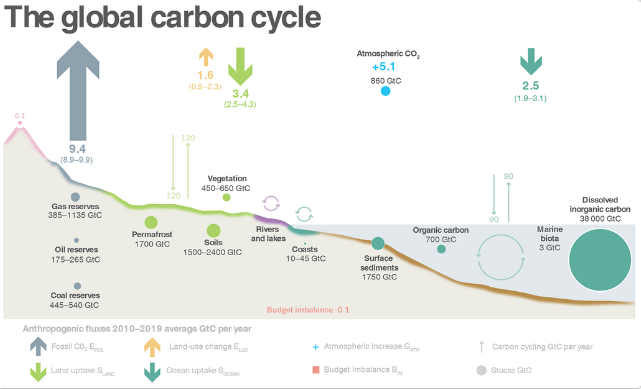
Figure 1 : Schematic representation of the overall perturbation of the global carbon cycle caused by anthropogenic globally for the decade 2010-2019
The global COVID-19 lockdowns caused fossil carbon dioxide emissions to decline by an estimated 2.4 billion tonnes in 2020 – a record drop according to researchers.
The fall is considerably larger than previous significant decreases – 0.5 (in 1981 and 2009), 0.7 (1992), and 0.9 (1945) billion tonnes of CO2 (GtCO2). It means that in 2020 fossil CO2 emissions are predicted to be approximately 34 GtCO2, 7% lower than in 2019.
Emissions from transport account for the largest share of the global decrease. Those from surface transport, such as car journeys, fell by approximately half at the peak of the COVID-19 lockdowns. By December 2020, emissions from road transport and aviation were still below their 2019 levels, by approximately 10% and 40%, respectively, due to continuing restrictions.
Total CO2 emissions from human activities – from fossil CO2 and land-use change – are set to be around 39 GtCO2 in 2020.
For more information, see the article : https://essd.copernicus.org/articles/12/3269/2020/.