A set of 17 studies results have been published in a special issue of Philosophical Transactions B of the Royal Society. These studies have used data from the Integrated Carbon Observation System (ICOS) and showed how nature and crops in Europe respond to extremely dry conditions, such as occurred over the last three summers, 2018-2020.
Researchers from Laboratoire des Sciences du Climat et de l’Environnement (LSCE), coauthors of many of these studies, show, for example, that in 2018 the strength of the terrestrial vegetation carbon sink decreased by 18 percent, and crops produced the lowest yields in decades.
The 2018 summer recorded the largest area in Europe under extreme drought ever observed. Temperature records were broken in many regions of Central Europe and the UK, fires broke out in the Nordic countries, and several countries suffered from extensive crop failures.
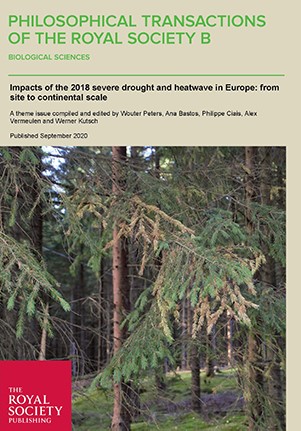
According to the results presented, the plants first benefited from warm and sunny conditions in spring 2018, but subsequently did not have enough water available to their roots when the summer heat wave hit. Grasslands “browned-down” during the drought, causing shortages of hay for cattle, and many crops produced the lowest yields in decades, causing financial losses for many industrial sectors. “Several studies show that the dryness of the soil affected the plants even more than e.g. the high temperature and the humidity of the air,” explains Ana Bastos, a scientist at Max Planck Institute, Germany, and one of the lead authors of the theme issue.
Many of the studies found that on the European scale, the forests protected themselves by reducing their evaporation and growth, leading to decreased uptake of carbon dioxide. Carbon sinks decreased in general by 18% according to a study covering 56 sites.
The dry conditions even turned some ecosystems from sinks into sources. However, recently-rewetted peatlands seemed to survive better e.g. due to new plant growth. This is good news since rewetting peatlands is one of the means widely used to mitigate the consequences of the climate change.
Furthermore, these studies show that the response of the vegetation to an extremely dry summer is strongly dependent on the conditions of the previous spring and even winter. In some parts of Europe, the winter 2018 was wet, leaving a lot of soil moisture in the ground, while spring was sunny and came early - this caused the vegetation to grow more than average in spring, taking up more carbon from the atmosphere than usual. In some places, this early spring growth was enough to offset the reduction of carbon uptake later in summer.
The 17 studies represent the work of over 200 scientists gathering a vast amount of data, points out Alex Vermeulen, co-organiser of the study and Director of the ICOS Carbon Portal: “We had open data exchange during process, resulting in the unique data sets openly available through ICOS Carbon Portal”.